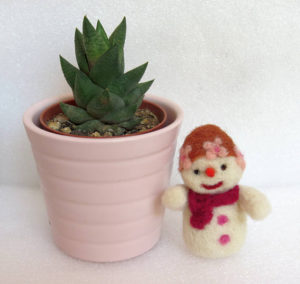

My tiny needle felted snowmen bring joy and smiles and the best wishes for health and happiness with this red and white traditional Bulgarian bracelet. It is called ‘Martenitsa’, named after the Bulgarian name of the month of March – ‘Mart.’
Martenitsa is a handmade accessory-mascot that is made from red and white strings twisted together. It has different forms– from bracelets and necklaces to broches in various shapes. The red color represents Life (blood) and the white color represents Purity/Happiness. Martenitsa is a symbol of the coming spring.
Following the tradition, all Bulgarians wear a Martenitsa on the 1st of March to celebrate the coming spring and to have health and happiness in their lives. According to the tradition, people wear Martenitsas for a certain period, the end of which is usually associated with the first signs of spring – seeing a stork or a fruit tree in blossom. When it happens people can tie them on a blossoming tree. The tradition is to wear Martenista in March, more and more Bulgarians wear Martenitsas all year round for health, happiness and luck. I like wearing it during the whole year : )
In the Bulgarian folklore, the month of March (Mart) is represented by Grandma March (Baba Marta). The belief is that the month of March is an old lady who changes her moods thus, the weather changes all the month. By wearing the red and white colors of Martenitsa our predecessors asked Baba Marta for mercy. They hoped that it would make winter pass faster and bring spring. Celebrating 1st of March kids receive Martenitsas from Baba Marta (a woman dressed in a folkloric custom). She gives them Martenitsas with best wishes for good health and happy childhood.
The tradition of wearing Martenitsas and celebrating the upcoming spring dates back from many centuries ago back to the VIIth century when the Bulgarian empire was founded on the Balkans. Some of the Balkan countries have similar traditions of wearing red and white mascots.
There are legends about the first Martenitsa. I’ll share my favorite one : )
More than a dozen centuries ago, the proto-Bulgarian ruler Khan Asparuh (also known as Isperih) left his home in the distant Tibet Mountains in search of fertile lands for his people. He dreamt to establish the new Great Bulgaria Empire. He passed through many rivers and mountains until the finally reached the lands of the Slavs in the Balkans. They greeted him and his people as dear guests.
Khan Asparuh was enchanted by the beauty of this land. The proto-Bulgarians began the celebrations of the founding of the new country on this land with a huge bon-fire. According to the tradition, the proto-Bulgarians had to burn a special herb in the fire to express their gratitude to their main God Tangra. Khan Asparuh didn’t have the herb which was growing in abundance in his birth place, the area along the river Volga. His heart was heavy with sadness. He was missing his sister Huba and the lands where he was born and grew up.
The Khan needed to be alone and walked away from the celebration. He needed a sign from God to show him that this new land will become the new Great Bulgarian Empire.
While he was watching the celebrations in the distance a miracle happened. A swallow perched on Khan Asparuh’s shoulder. It was bringing a gift from his sister, Huba. She had felt that he needed encouragement and had sent him a gift for support and good wishes. She sent him a small bouquet with the herb tied with a white string to the leg of the swallow. But during the long flight the wing of the bird was hurt and some blood drops dyed the white string half in red.
The Khan was so happy to see the green bunch. He got his sister’s greeting by the knots she had made, and so he pinned the bunch on his chest. Khan Asparuh burned the herb in the bon fire following the tradition for the celebrations and decided that this will be the land for the new Great Bulgarian Empire.
The Khan ordered his men to put a small bunch of twisted red-and-white thread on that day every year for health and heavenly blessing. The legend says that this happened in the beginning of the spring.
Source: National Geographic